GHG quota using biomethane as a revenue lever

The GHG quota for biomethane is a key economic lever in the marketing of advanced fuels. Green Trading Energy analyzes regulatory requirements, evaluates the CI value, and structures GHG quota management for biomethane in such a way that revenue potential becomes transparent and controllable.

The most important sales market for advanced fuels such as biomethane is currently in the transport sector. Biomethane plays an important role in meeting statutory GHG reduction targets, particularly in heavy-duty transport and alternative fuels. The statutory GHG reduction quota will increase significantly in the coming years, thereby increasing the demand for low-emission fuels.

GHG quotas have become a key economic lever in biomethane marketing. We systematically analyze and structure GHG quota management to make revenue potential transparent and controllable.

  • Assessment of CI value and emission quality as a direct revenue factor
  • Classification of regulatory developments (EEG, RED III, GHG quota)
  • Analysis of market price scenarios and reduction paths
  • Structuring of revenue distribution between producer and marketer

The goal is a structured revenue architecture that systematically interlinks market price, emission quality, and regulatory framework conditions.
How the quota sharing model works

In addition to traditional marketing models such as fixed-price or TTF-based contracts, the quota-sharing model is becoming increasingly important.

The quota-sharing model combines market price, emission quality (CI value), and regulatory framework conditions to create a transparent revenue logic in GHG quota management.

1. Input

GHG price (€/t CO₂)
Amount of biomethane (MWh)Emission value (CI)

2. GHG reduction

Legally defined (t CO₂eq)

3. Output

Total GHG revenue
GHG revenue per MWh

4. Revenue sharing

Producer (e.g., 80%)
Marketer (e.g., 20%)

With quota sharing, the proceeds from GHG quotas are divided transparently between the producer and the marketer. The producer supplies biomethane, while the marketer generates and markets the GHG quota. The proceeds are directly based on the current quota market and the emission quality of the biomethane.

The economic leverage lies in particular in the emission value (CI). Improvements in emission quality directly increase revenues and change the distribution of revenues in the model. Revenue distribution is rule-based and transparent – without opaque margin mechanisms. This makes the quota sharing model an active control instrument in the strategic revenue optimization of biomethane and GHG quotas.

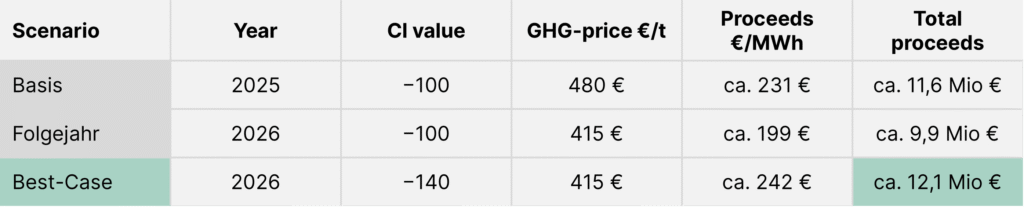
The following scenario comparison (2025 / 2026 / best case) shows how strongly emission quality and market price influence revenues.

GHG quota for biomethane with CI value, GHG price, and revenue overview

Revenues on the producer side (e.g., 80% share)

The economic value of GHG quotas is determined by the combination of biomethane volume, emission value (CI), and current GHG market price.

The amount of CO₂ saved depends directly on the emission quality of the biomethane (CI value). Improvements in the emission value therefore increase the potential quota value and can partially offset price declines on the market.

The values and scenarios presented are for illustrative purposes only and are based on assumptions. They do not constitute a binding forecast or recommendation for action.

1. Determine the amount of biomethane
The starting point is the amount of biomethane produced per year (e.g., 33 GWh).

2. Convert the amount of energy to the applicable calorific value (Hs → Hi)
The amount of energy is converted to the relevant calorific value in order to obtain the actual amount of energy that can be credited.

3. Calculate CO₂ savings
Based on the emission value of biomethane (CI value), calculate how many tons of CO₂ are saved by using biomethane instead of fossil reference fuel.

4. Determine the market value of the GHG quota
Multiply the amount of CO₂ saved by the current GHG quota price.
→ Result: Total value of the GHG quota generated

5. Allocate proceeds (quota sharing)
The total value is allocated between the producer and the marketer according to the agreed split (e.g., 80%/20%).

Key findings

GHG revenue declines with a constant CI value due to rising reduction targets (2026 vs. 2025).

An improvement in the emission value (CI) can overcompensate for this effect and becomes a key economic lever.

The quota-sharing model creates transparency and clear revenue sharing between producers and marketers.

Would you like to transparently evaluate and strategically optimize GHG revenue from biomethane?

We analyze emissions data, assess current GHG market prices, and design appropriate quota-sharing models for your biomethane marketing efforts.